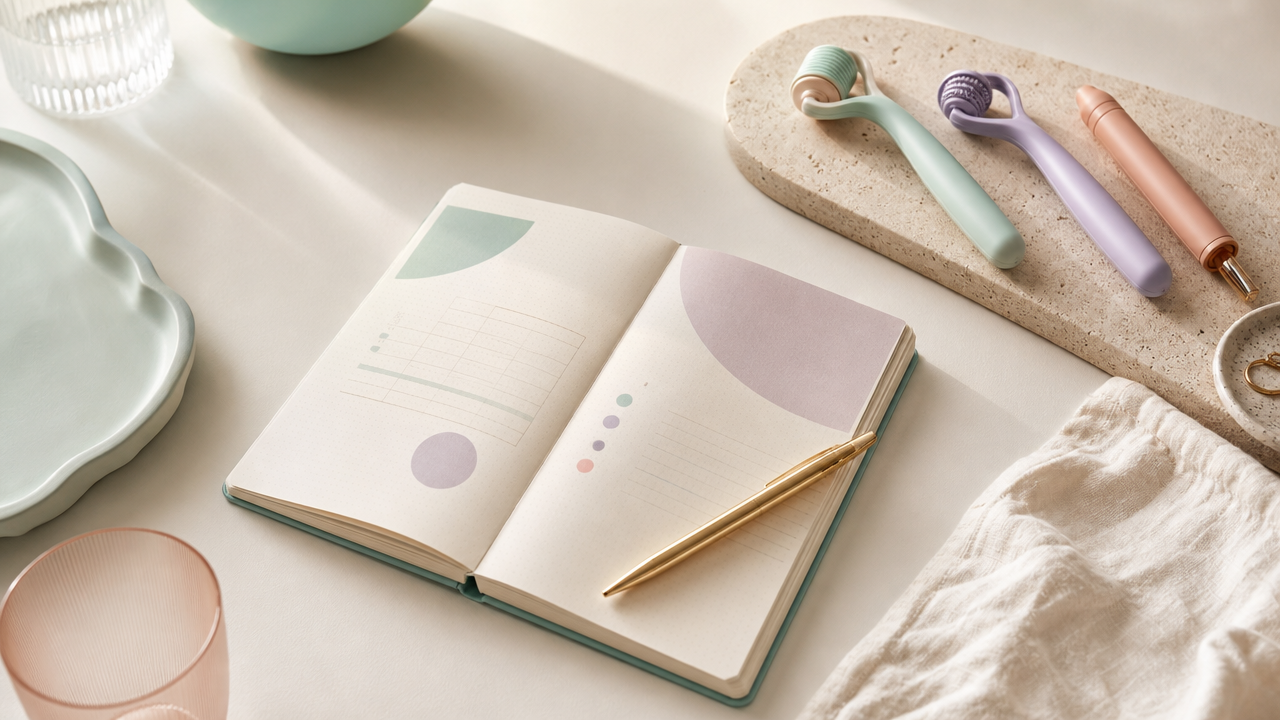
There is no single “best” at-home microneedling tool. There are categories with different tradeoffs, and the right pick depends on your goals, your skin, and a professional’s input. This is a documented comparison of the common types and what to record once you choose, not a ranking that promises results.
Log Notes. “Best” here means best-documented and most-discussed, not most effective or safest for you. We do not recommend needle depths or techniques; those are clinical decisions. This is about understanding the categories and tracking your own experience.
How do the main at-home tool types differ?
Most consumer tools fall into three buckets, each with a familiar tradeoff:
- Rollers. A drum of fine needles rolled across the skin. Inexpensive and common; hard to control evenly, and the rolling motion is debated versus vertical approaches.
- Stamps. A flat head pressed straight down. More controlled placement around small areas like the nose, slower to cover the whole face.
- Pens. A motorized tip that moves vertically. Easier to use consistently and the format most clinical devices share, though quality and price vary enormously.
Notice that the comparison is about control, coverage, and consistency, not “which one works best.” Whether any of these suits your skin, and at what specification, is a question for a professional. The FDA notes that only a limited number of microneedling devices have marketing authorization, and that not all products sold are medical devices, which is worth knowing before you buy anything.
What should you look for and verify?
Before a tool earns a place in your routine, a few checks keep you grounded:
- Hygiene design: can it be kept clean, and are heads replaceable? Infection risk is the FDA’s headline caution.
- Clear specifications from the manufacturer rather than vague marketing.
- Regulatory status: is it a cleared device or a cosmetic gadget? They are not the same.
- A professional’s opinion on whether at-home use fits your skin at all.
If a product leans on dramatic before-and-after promises instead of plain specifications, treat that as a reason for caution, not excitement.
Reviews deserve the same skepticism. A wall of five-star ratings tells you a tool is popular, not that it is right for your skin or used safely. Look instead for specifics you can verify: replaceable heads, a named manufacturer, clear regulatory status, and instructions that describe cleaning and care rather than promising outcomes. The tools worth considering tend to be modest in their claims and precise in their documentation, the opposite of the ones that sell hardest.
What should you track once you pick one?
Choosing the tool is step one; the value comes from the record. Log the device, each session’s date, how your skin reacted, and how long recovery took, the same discipline covered in tracking at-home sessions. An app like Dosefi makes this concrete: it stores the device and depth you used, a photo, and the date for every session, and puts the next one on your schedule. Pair that with honest cost tracking and, over a few months, you can see whether a given tool earned its place. A log turns “I think this one is better” into something you can actually check.
A grounded takeaway
The best at-home microneedling tool is the category that fits your goals and your professional’s guidance, that you can keep clean, and whose specifications are clear. Verify regulatory status, prioritize hygiene, and let your own tracked experience, not a marketing photo, decide whether it stays in your routine.
Sources
- “Microneedling Devices” (U.S. Food and Drug Administration). FDA overview of device clearance and the distinction between medical devices and other products.